
Helical vs Blade Static Mixer Elements: Which Element Design?
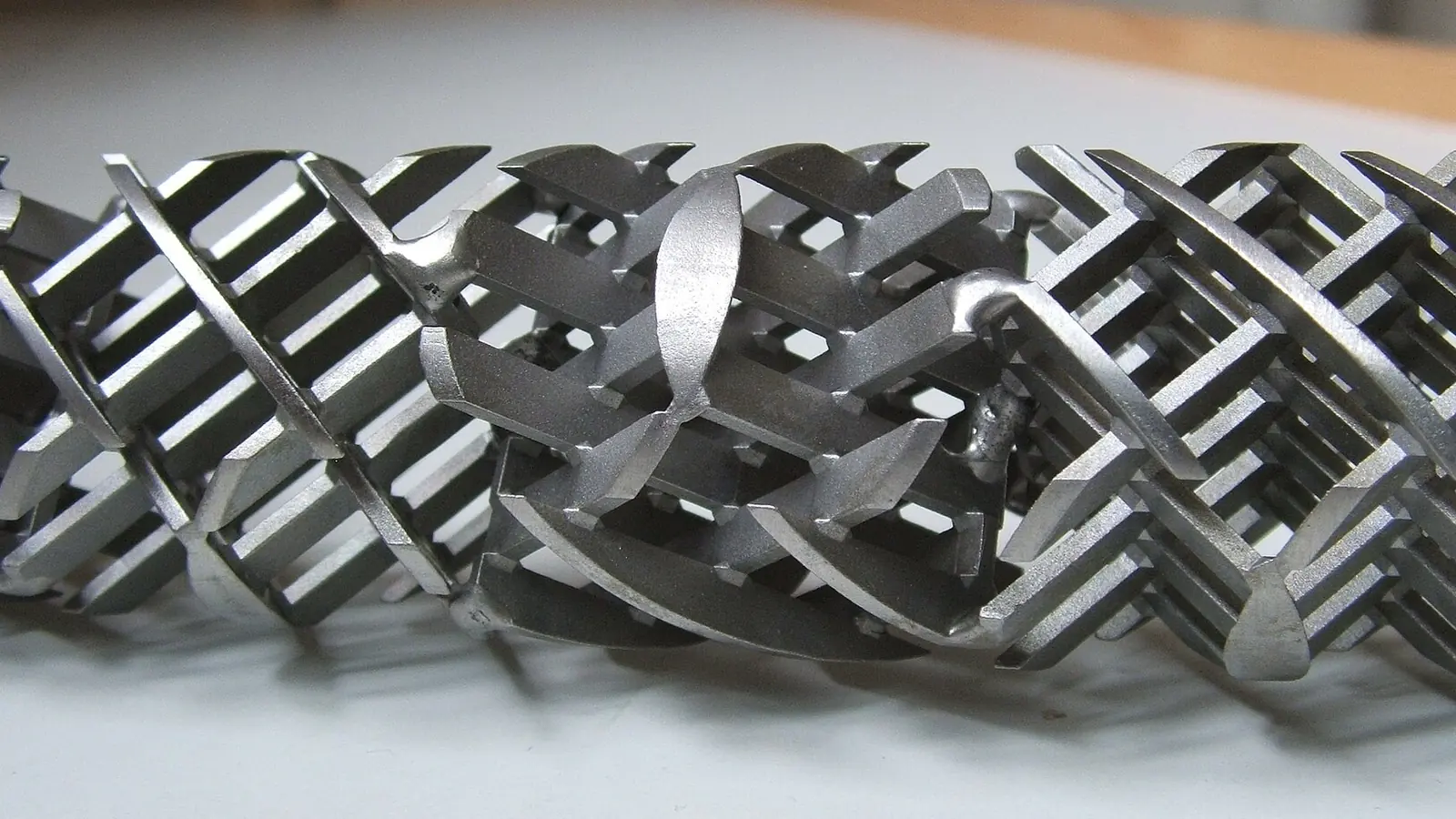
Table of Contents
KEY TAKEAWAYS
- Blade elements are the turbulent-flow workhorse (Re > 2,000) — best mixing per unit ΔP for water, dosing, and most liquid service.
- Helical elements are built for laminar/viscous flow (Re < 2,000) — they force radial mixing that laminar flow can't produce naturally.
- Blade = lower K-factor (less ΔP per element); helical = higher K but necessary for viscous polymers and melts .
- Non-clog elements are the third option — open-channel design for slurries and wastewater solids.
- Many suppliers offer both; the choice is dictated by your Reynolds number, not preference.
1. Two Geometries, Two Flow Regimes
Element geometry is matched to flow regime:
- Blade elements — angled plates/blades that chop and redirect flow. They work best in turbulent flow, where eddies already exist and the blade multiplies cross-stream exchange.
- Helical elements — twisted ribbons that split, rotate, and recombine the stream. They work in any regime, but are essential in laminar flow where turbulence is absent.
2. Side-by-Side
| Factor | Blade | Helical |
|---|---|---|
| Flow regime | Turbulent (Re > 2,000) | Laminar & turbulent |
| Mixing mechanism | Turbulence multiplication | Divide-rotate-recombine |
| Radial mixing | Good | Excellent (laminar) |
| K-factor (ΔP) | Lower | Higher |
| Viscous service | Poor | Native fit |
| Solids service | Poor | Poor (use non-clog) |
| Standard count | 6 elements | 6–12 elements |
| Typical duty | Water dosing, chemicals | Polymers, melts, slurries |
3. When Blade Wins
Your duty is turbulent liquid mixing:
- Water treatment dosing (coagulant, chlorine, pH)
- Chemical injection in process lines
- Cooling-water treatment
- Any Re > 2,000 water-like fluid
Why: blade elements deliver the target CoV at the lowest ΔP — the most efficient energy-to-mixing conversion in turbulent flow.
4. When Helical Wins
Your duty is viscous or laminar:
- Polymer blending (masterbatch, additives)
- Resin/epoxy mixing
- High-viscosity fluids (molasses, syrups, oils)
- Melt homogenization in extrusion
Why: in laminar flow there's no turbulence to multiply — helical elements physically push center fluid outward and wall fluid inward (radial mixing), which is the only way to homogenize slow-moving viscous streams.
5. The Third Option: Non-Clog Elements
For slurries, wastewater, and solids-laden flows, open-channel non-clog elements avoid plugging. They trade some mixing intensity for a large free area — the standard choice for sludge and high-solids duty.
6. Decision Table
| Your duty | Element |
|---|---|
| Water/chemical dosing, turbulent | Blade |
| Viscous polymer blending | Helical |
| Laminar slow flow | Helical |
| Slurries / wastewater solids | Non-clog |
| Space-constrained, turbulent | Wafer (blade-type) |
| Mixed regime (variable flow) | Helical (handles both) |
7. FAQ
Q: Can helical elements handle turbulent flow? Yes — they mix in both regimes, just at higher ΔP than blade. Use blade when turbulent is guaranteed.
Q: Which gives better mixing at the same ΔP? In turbulent flow, blade. In laminar flow, helical is the only real option — the comparison doesn't apply.
Q: Do you supply both types? Yes — blade (standard), helical (custom), and non-clog. Send us your duty for a recommendation.
Your Action Roadmap
- Calculate Re — the flow regime decides everything.
- Pick the element family — blade / helical / non-clog.
- Confirm ΔP — K-factor from datasheet.
- Get a quote — stock or custom elements.
→ Send us your flow & viscosity data for an element recommendation — typically answered within 24 hours.
NEXT STEP
Need a Static Mixer Sized for Your Line?
Send us your requirements — our team responds within 24 hours with pricing and lead time.
Written by
Ray ChanStatic Mixer Sourcing Specialist. Ray helps global importers and plant engineers source reliable inline mixing products.