
How Does a Static Mixer Work? A Complete Guide to Motionless Inline Mixing
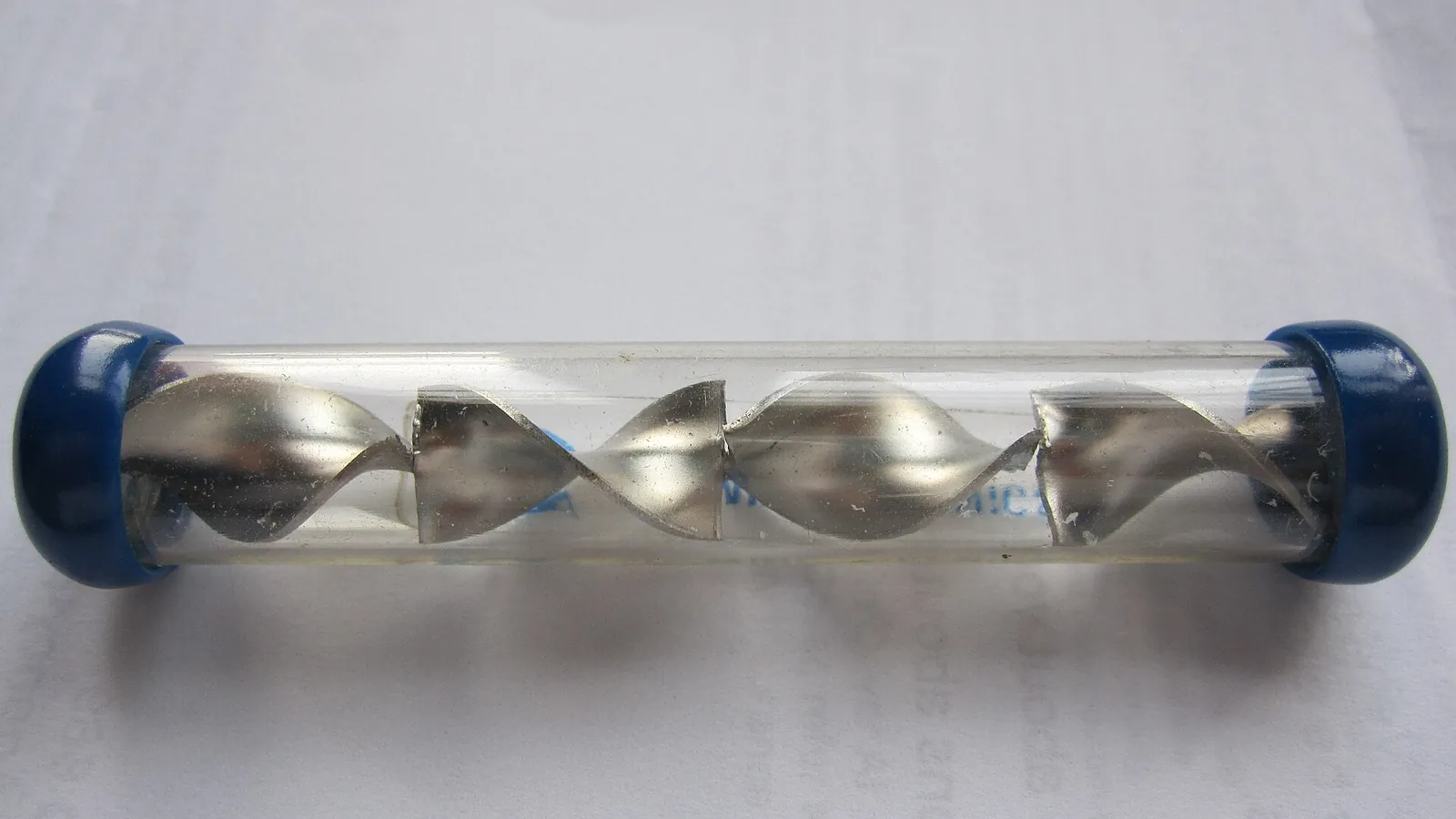
Table of Contents
KEY TAKEAWAYS
- A static mixer uses fixed internal elements to divide, rotate, and recombine fluid streams — zero moving parts, zero external energy input beyond pump pressure.
- Mixing quality is measured by Coefficient of Variation (CoV) — below 0.05 is typically "well mixed"; below 0.01 is near-perfect homogeneity.
- Pressure drop (ΔP) typically ranges 0.2–2.0 bar depending on element count, flow rate, and fluid viscosity — every element adds resistance.
- Choose elements by flow regime: Blade-type for turbulent flow (Reynolds > 2,000), Helical-type for laminar/viscous flow (Reynolds < 2,000).
- Static mixers are maintenance-free — no seals, no bearings, no motors — making them the lowest-TCO mixing option for continuous processes.
1. What Is a Static Mixer?
A static mixer — also called a motionless mixer or inline mixer — is a pipe or tube section containing fixed, geometrically shaped mixing elements. As process fluid flows through, the elements repeatedly divide the stream, rotate it, and recombine it, achieving homogeneous blending with no moving parts.
Core anatomy:
| Component | Role |
|---|---|
| Housing (pipe/tube) | Contains the elements; connects via NPT, flanged, or plain ends |
| Mixing elements | Fixed geometry (helical, blade, or non-clog) that splits/rotates flow |
| Injection port (optional) | Adds a secondary stream (chemical, polymer, gas) directly into the mixer |
Why "motionless" matters: Because there are no rotating shafts, seals, or motors, static mixers:
- Require no maintenance (no wear items, no lubrication)
- Consume no energy beyond the pump already moving the fluid
- Run 24/7 continuously without supervision — ideal for water plants and chemical lines
Industries that use them: water and wastewater treatment, chemical dosing, pH control, polymer blending, oil & gas, food & pharmaceutical (sanitary), pulp & paper.
2. Working Principle: Divide, Rotate, Recombine
The mixing principle is best understood as three repeated actions:
- Divide — The leading edge of each element splits the incoming flow into two or more streams.
- Rotate — Helical or blade geometry rotates each stream around the pipe axis.
- Recombine — Streams merge at the element exit, then enter the next element and repeat.
The math: A static mixer with N elements creates up to 2^N stream divisions. Practical example: a 6-element helical mixer produces up to 64 divisions — far beyond what mechanical turbulence alone achieves in a plain pipe of the same length.
Flow regimes matter:
- Turbulent flow (Reynolds > 2,000): Blade-type elements dominate — they maximize cross-stream mixing with minimal pressure loss.
- Laminar flow (Reynolds < 2,000, viscous fluids): Helical elements work best — they force radial mixing that laminar flow cannot produce on its own.
Mixing quality metric: Engineers quantify homogeneity with the Coefficient of Variation (CoV) — the standard deviation of a tracer concentration divided by its mean:
| CoV value | Mixing quality |
|---|---|
| > 0.10 | Poor — visible inhomogeneity |
| 0.05 – 0.10 | Acceptable for many dosing applications |
| < 0.05 | Well mixed (industry standard target) |
| < 0.01 | Near-perfect homogeneity (critical processes) |
The more elements, the lower the CoV — at the cost of higher pressure drop (see §4).
3. Static Mixer vs. Dynamic Mixer: Which Do You Need?
| Factor | Static mixer | Dynamic (mechanical) mixer |
|---|---|---|
| Moving parts | None | Motor, shaft, seals, impeller |
| Maintenance | Zero (no wear items) | Seals & bearings on a schedule |
| Energy cost | Only pump pressure | Motor electricity (kW range) |
| Continuous flow | Native fit | Possible but more complex |
| Batch operation | Less suited | Native fit |
| Space | Inline — fits existing pipe | Requires tank/vessel + footprint |
| Capital cost | Low (pipe section) | High (motor + gearbox + vessel) |
| Best for | Continuous inline dosing, 24/7 plants | Batch mixing, solids suspension, high-shear |
Rule of thumb: If your process is continuous flow in a pipe and the goal is chemical/fluid homogenization, a static mixer is almost always the lower-cost, lower-maintenance choice. Choose a dynamic mixer only for batch work, solid-liquid suspension, or shear-sensitive reactions.
4. Pressure Drop: The Real Cost of Mixing
Static mixing is "free" only in the sense that it uses the fluid's own energy. That energy comes from pressure drop (ΔP) across the elements — paid by the pump.
Typical ΔP ranges (industry practice):
| Element count | Approx. ΔP contribution |
|---|---|
| 3 elements | Low — 0.1–0.5 bar at moderate flow |
| 6 elements | Medium — 0.3–1.0 bar |
| 12 elements | High — 0.5–2.0 bar+ |
ΔP depends on: element type, number of elements, flow velocity, fluid density, and viscosity. A rough working rule: ΔP scales roughly linearly with element count and quadratically with velocity — doubling flow roughly quadruples pressure drop.
Design trade-off: More elements = better mixing (lower CoV) but higher ΔP. Most standard configurations ship with 6 elements as the default, with 12-element versions for demanding applications. Always verify the pump can absorb the added ΔP at design flow.
Practical guidance: For a new line, size the mixer so ΔP stays below 10% of pump head where possible — this keeps the pump from needing a retrofit.
5. How to Select & Size a Static Mixer (6-Step)
Step 1 — Define the duty. Fluid(s), flow rate (m³/h or L/min), viscosity, density, and the mixing goal (dosing, pH, homogenization).
Step 2 — Determine the flow regime. Calculate Reynolds number:
Re = (ρ × v × D) / μ
ρ = density (kg/m³), v = velocity (m/s), D = pipe diameter (m), μ = dynamic viscosity (Pa·s)
Step 3 — Choose the element type.
- Re > 2,000 → Blade-type (low ΔP, turbulent mixing)
- Re < 2,000 → Helical-type (radial mixing in laminar flow)
- Solids/slurry → Non-clog elements (open channel, larger free area)
Step 4 — Match pipe size. Select the mixer diameter to match (or slightly reduce) the existing line size. Standard sizes: 1/2" to 24" (PVC), up to larger for stainless.
Step 5 — Estimate pressure drop. Use the manufacturer's K-factor (ΔP per element) or a sizing calculator: ΔP = K × N × (ρv²/2), where N = element count, K = element-specific resistance coefficient.
Step 6 — Check standards & materials. Threads (ANSI B1.20.1 NPT / BSPT), pipe schedule (40/80), material compatibility:
- PVC — water, mild chemicals, ≤60°C (NSF 61 option for potable water)
- PP — wider chemical resistance
- PVDF — aggressive chemicals, higher temperature
- 316 SS — sanitary/hygienic, corrosive, high-pressure
6. Applications: Where Static Mixers Earn Their Keep
| Application | What gets mixed | Typical elements |
|---|---|---|
| Water treatment | Coagulant, flocculant, chlorine | Blade, 6-element |
| Wastewater | Polymer, pH adjusters, odor control | Non-clog |
| Chemical dosing | Inhibitor, acid/base, biocide | Blade, 6-element |
| Polymer blending | Masterbatch, additives (viscous) | Helical |
| Oil & gas | Corrosion inhibitor, methanol | Blade/Helical |
| Food & pharma | CIP chemicals, flavor/color (sanitary) | Sanitary blade |
Each application has its own sizing logic — water treatment flash mixing targets CoV < 0.05 in < 1 second; polymer blending may accept longer residence for shear-sensitive fluids.
7. Common Myths & FAQs
Myth 1: "Static mixers are only for low-viscosity fluids." False — helical elements were designed for viscous/laminar flow. They mix everything from gases to polymer melts.
Myth 2: "No moving parts means no pressure loss." False — the elements themselves create ΔP. It's the energy trade for mixing quality.
Myth 3: "Bigger pipe = better mixing." False — mixing depends on velocity. Oversized mixers may under-mix because velocity drops.
FAQ: How long does a static mixer last? Indefinitely in compatible service — there are no wear parts. Material degradation (e.g., PVC over-temp) is the only limit.
FAQ: Can a static mixer handle solids? Yes, with non-clog/open-channel elements — but avoid abrasive slurries at high velocity.
FAQ: Do you offer custom sizes and OEM? Yes — custom diameters, lengths, end connections, and injection ports are available. Contact us with your duty spec for sizing support.
Your Action Roadmap
- Gather your duty data — flow, viscosity, media, mixing goal (we'll walk you through it).
- Run the numbers — use our sizing calculator or send us your spec for a free ΔP estimate.
- Pick materials & ends — PVC (potable, NSF 61), PP, PVDF, or 316 SS; NPT, flanged, or plain.
- Get a quote — custom and in-stock options, with drawings and certifications.
→ Send us your process spec for a sizing & pressure-drop recommendation — no obligation, typically answered within 24 hours.
NEXT STEP
Need a Static Mixer Sized for Your Line?
Send us your requirements — our team responds within 24 hours with pricing and lead time.
Written by
Ray ChanStatic Mixer Sourcing Specialist. Ray helps global importers and plant engineers source reliable inline mixing products.