
Static Mixers for Water Treatment: Flash Mixing, Dosing & Disinfection Guide
Table of Contents
KEY TAKEAWAYS
- Static mixers deliver flash mixing in < 1 second at CoV < 0.05 — beating mechanical flash mixers on both speed and uniformity for coagulant dosing.
- Chlorine/hypochlorite mixing with a static mixer cuts contact-time variability and reduces chemical overfeed — a real cost line in municipal plants.
- PVC (NSF 61) covers most potable-water dosing; PP for aggressive coagulants; PVDF for chlorine dioxide and high-concentration oxidizers.
- Typical ΔP across a 6-element mixer at design flow: 0.3–1.0 bar — check the pump can absorb it before retrofitting.
- No moving parts = no seals, no lubrication, no maintenance schedule — the defining advantage for 24/7 water plants.
1. Why Water Treatment Runs on Static Mixers
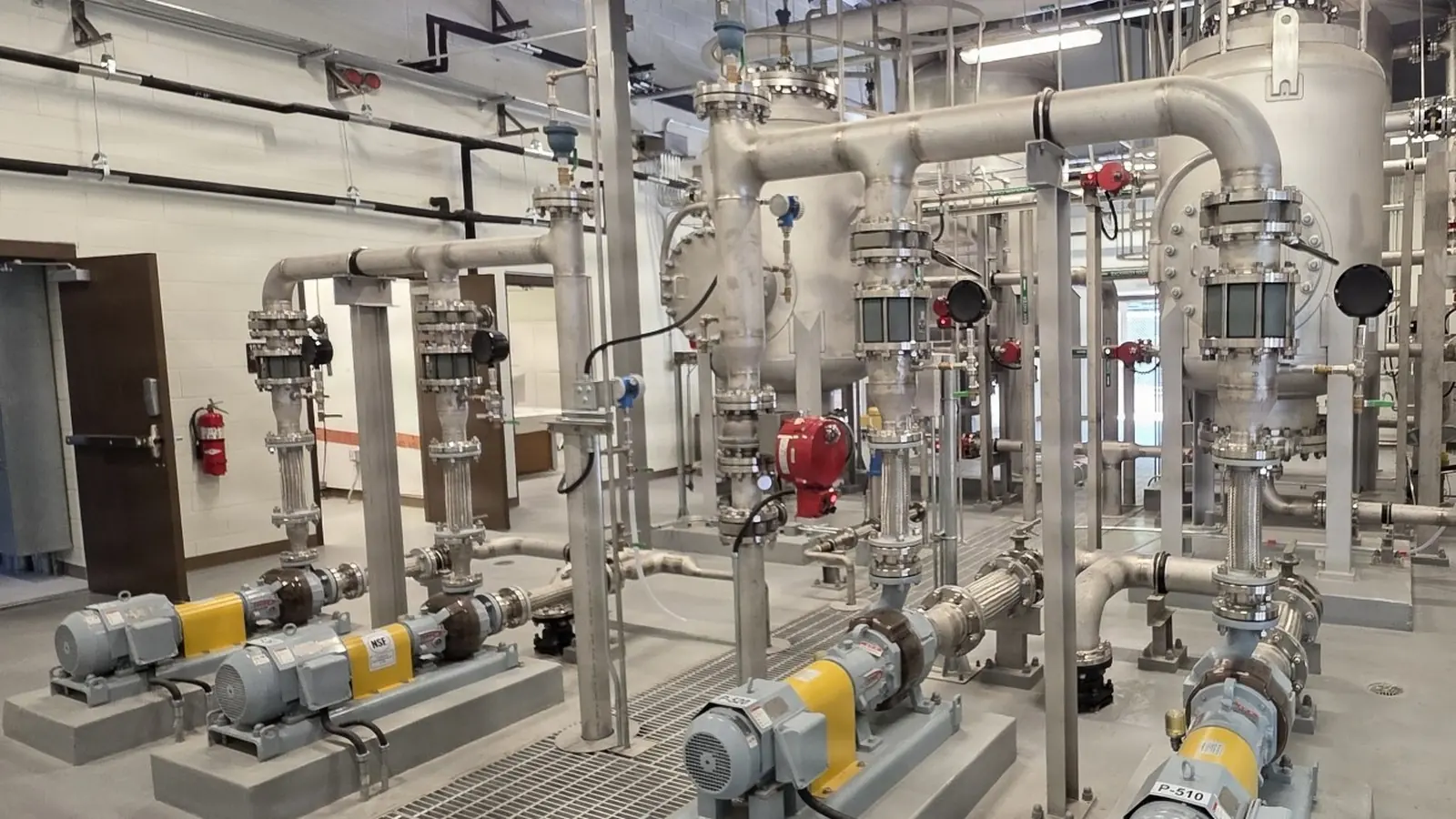
Water treatment is a continuous-flow, 24/7 process where chemicals must be mixed into the stream instantly and uniformly. Mechanical flash mixers (motor + impeller in a tank) work — but they bring rotating equipment, seals, energy use, and maintenance to a process that otherwise runs unattended.
A static mixer does the same job inline, with no moving parts: the pipe itself becomes the mixer. This is why municipal and industrial water plants increasingly specify static mixers for:
- Coagulation — alum/ferric salts dispersed instantly for floc formation
- Flocculation — gentle, controlled mixing for floc growth
- Disinfection — chlorine, hypochlorite, chlorine dioxide, UV pre-treatment dosing
- pH adjustment — acid/base neutralization inline
- Anti-scalant / corrosion inhibitor dosing — precise, uniform chemical feed
2. Flash Mixing: Coagulation & Flocculation
The problem
Coagulant (alum, polyaluminum chloride, ferric sulfate) must disperse completely and instantly into raw water. If it arrives as concentrated pockets, floc forms unevenly → turbidity breakthrough → higher chemical cost and filter loading.
The static mixer solution
Inline mixing gives near-instant dispersion with CoV < 0.05 — the industry-standard mixing target. Key parameters:
| Parameter | Typical value |
|---|---|
| Mixing time | < 1 second (flash mixing) |
| Velocity gradient (G) | 300–1000 s⁻¹ for coagulation |
| CoV target | < 0.05 |
| Elements | 6-element blade type (turbulent) |
| ΔP | 0.3–1.0 bar at design flow |
Practical note: Flocculation itself is gentler (G = 20–80 s⁻¹) and usually done in tanks/pipes with lower shear — static mixers handle the flash stage, while floc grows downstream.
3. Disinfection Dosing: Chlorine & Hypochlorite
The problem
Chlorine (gas), sodium hypochlorite, or chlorine dioxide must be uniformly distributed — under-dosed zones mean pathogen risk; over-dosed zones mean DBP (disinfection byproduct) formation and chemical waste.
The static mixer solution
A mixer immediately downstream of the injection point homogenizes the disinfectant across the pipe cross-section. Benefits:
- Consistent CT (concentration × contact time) — the regulatory compliance metric
- Reduced chemical overfeed — plant owners report 5-20% chemical savings vs. unmixed injection
- Works with existing piping — retrofits into the discharge line
Materials: PVC (NSF 61) for hypochlorite at standard concentrations; PVDF for chlorine dioxide and high-concentration oxidizer service.
4. Chemical Dosing & pH Control
For pH adjustment (acid/base), anti-scalant, corrosion inhibitor, and biocide dosing, the mixer ensures the chemical sees the whole flow, not a thin boundary layer. This matters most at low dose rates — where unmixed injection can leave entire pipe segments untreated.
Injection port consideration: A static mixer with an integrated chemical injection port (female NPT or flanged) places the additive stream directly into the mixing zone — the recommended configuration for dosing lines.
5. Sizing a Static Mixer for Water Treatment
Step 1 — Flow rate. Design flow (m³/h or GPM) fixes pipe diameter and velocity.
Step 2 — Reynolds number. Confirm turbulent flow (Re > 2,000) for blade elements. At low flows, helical elements still mix — at the cost of higher ΔP.
Step 3 — Element count. Start with 6 elements; add elements if the CoV target is stricter than 0.05.
Step 4 — Pressure drop. ΔP ≈ K × N × (ρv²/2). Verify the pump has head margin — a common retrofit failure is undersized pumps after mixer installation.
Step 5 — Material & standards. PVC (NSF 61) for potable water; PP for aggressive coagulants; PVDF for oxidizers. Threads ANSI B1.20.1 (NPT) or flanged.
Step 6 — End connections. Threaded for small lines (≤2"), flanged for larger municipal lines.
6. Materials for Water Service
| Duty | Recommended material | Why |
|---|---|---|
| Potable water dosing (chlorine, pH) | PVC (NSF 61) | Lowest cost, potable-certified |
| Alum / ferric / aggressive coagulants | PP | Broader chemical resistance |
| Chlorine dioxide / high-concentration oxidizers | PVDF | Highest chemical resistance |
| High pressure (>10 bar) or steam | 316 SS | Mechanical strength |
| Food & pharma (CIP) | 316 SS sanitary | Cleanability, CIP certification |
7. Static Mixer vs. Mechanical Flash Mixer
| Factor | Static mixer | Mechanical flash mixer |
|---|---|---|
| Moving parts | None | Motor, shaft, impeller, seals |
| Maintenance | Zero | Seal/bearing schedule |
| Energy | Pump pressure only | Motor kW |
| Mixing time | < 1 second | 10-60 seconds typical |
| Space | Inline | Tank + footprint |
| Capital | Low | High |
| Best for | Continuous dosing, retrofits | Batch or high-shear duty |
8. Common Questions
Q: Can a static mixer replace my mechanical flash mixer? For inline continuous coagulant dosing — yes, in most cases. Verify ΔP and mixing time against your duty; retrofits into existing piping are straightforward.
Q: Is PVC safe for potable water? PVC static mixers with NSF 61 certification are designed for potable-water contact — specify the certified configuration.
Q: How much pressure drop will it add? Typically 0.3–1.0 bar across a 6-element mixer at design flow. Check your pump's head margin.
Q: Do you supply mixers with injection ports? Yes — female NPT or flanged injection ports are available for chemical dosing lines.
Your Action Roadmap
- Confirm your duty — flow rate, chemicals, mixing goal (coagulation, disinfection, pH).
- Check the pump — head margin for added ΔP.
- Pick material + configuration — PVC/PP/PVDF, injection port, end connections.
- Get a quote — stock or custom, with NSF/ISO certifications.
→ Send us your water treatment duty spec for a sizing recommendation and quote — typically answered within 24 hours.
NEXT STEP
Need a Static Mixer Sized for Your Line?
Send us your requirements — our team responds within 24 hours with pricing and lead time.
Written by
Ray ChanStatic Mixer Sourcing Specialist. Ray helps global importers and plant engineers source reliable inline mixing products.